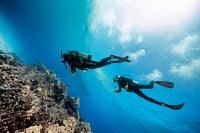
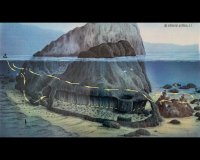
It is a wall dive inside a wide tunnel where you can find multiple yellow nudibranchs, scorpions, and polyps. Near the east exit of the tunnel, there is a chimney which reaches 8-10 meters deep. The use of a flashlight is necessary.
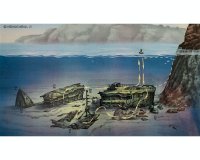
The Reggio Messina was built in Italy in 1970. It is a 122m long ferry. It sank in 1991 to make it an artificial reef. It is located on a sandy bottom at 35 meters, so it will be better to visit by the superior structure. It is now broken into 3 pieces.
Depth 4-45 meters. One of the most visited dives of the Medes Islands for its diversity and quantity of fauna, we will start the descent at the anchor buoy located on the south face of the Carall.
This is one of the most popular areas of the Montgrí coast for two reasons: on the one hand, the great versatility of its seabed, which allows for scuba diving initiations and deep dives, and on the other hand, the shelter it offers on Tramuntana days.
Underwater rocky complex of great beauty located about 200m from the coast. This underwater mountain formed by 3 points, which are at 14m, 22m and 27m, exhibit on their walls a large coating of red and yellow gorgonians, and towards the outside we will find large banks of cirvies and sorels.
Diving site where we find depths between 5 and 36 meters. Coral beds, oceanic posidonia between 8 and 15 meters and sandy areas from 22 meters, diving is done on the south side of Ferranelles island where we usually find the greatest diversity in the area.
North face of the meda Gran, the small rock that emerges from the sea gives its name to the dive site, low rocky bottom between 5 and 20 meters, towards Pedra de Deu we will find a greater depth with vertical walls that descend to 42 meters.
The continuation of the walls of the Pedra de Déu, continuing towards the east, leads us to the area of Pota del Llop, a name that comes from a formation on the outer wall that resembles a wolf's footprint.