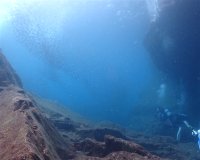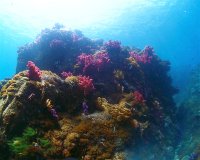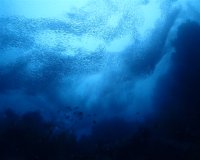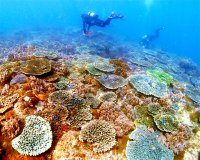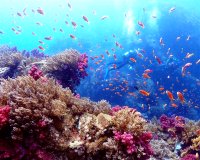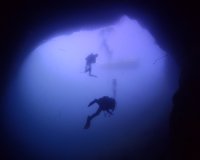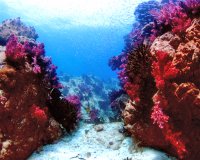
This dive site is characterized by clusters of both soft and hard corals at a depth of approximately 20 meters. Frogfish seek refuge within the crevices, and at times, schools of migratory fish make their way through. While a diverse range of fish gather in this area, the presence of strong currents often requires careful consideration of diving conditions. Although typhoons had previously caused significant damage to the hard corals, there are indications of recovery as of 2023, making this site all the more appealing to divers.
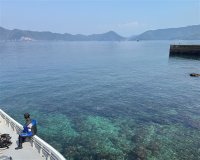
At Coral Beach on the uninhabited island of "Deer Island," National Park Special Protection Area No. 7, the water suddenly deepens from shallow to deep at a 45-degree angle. A rich ecosystem has been built here, with coral and shallow bays scattered about that serve as shelter for small fish, and deeper areas in the immediate vicinity. In summer, schools of yellow croaker appear in this area at a high rate, and kampachi, horse mackerel, squid, and other fish congregate to prey on them.
The southern slope of this area has been significantly eroded by powerful typhoon waves, resulting in dramatic cliffs that reach heights of 30 meters, offering a dynamic and visually striking landscape. As you navigate around the rocky formations, you’ll encounter steep drop-offs. Between depths of 25 to 35 meters, there are extensive terraces along the southern slope, making it an ideal location for enthusiasts of underwater ruins and unique topography. Occasionally, large fish also make appearances here, adding to the excitement, so keep a lookout for them.
Swim the mid-water to the tip with the coral ridge on your right, and you may see a large school of Japanese horn sharks descending from above. Large stingrays and turtles live in the neighboring waters, so you may be lucky enough to see them. After waiting for the school at the tip, you will see a gentle slope with a carpet of soft corals, gradually getting shallower and shallower until you reach the 5-meter safety stop, where kibibinago (sand eel) and other fish hang out. After the safety stop, we cross the natural maze created by the ridge and return to the boat.
This is the first site in the National Park Marine Protected Area, the “Flower Garden site #1“. It is a special dive site that is difficult to anchor and can be dived by drift diving; it is easy to dive safely in the shallow range of 5m-12m, but the current is often too fast, so choose the sea conditions and go there when it is not a problem.
Like a fault line, there is a mix of hard and soft corals on the monolithic rock. The depth ranges from 5-9 m, and the colony extends over more than 1 km in a straight line, with side holes next to the monolith allowing swim-throughs in some areas. Hard and soft corals coexist, and this type of landscape is rare in Japan. Sometimes rays, which can grow to over 2 meters, can be found hiding in the side holes. The scenery in shallow areas where light shines through is extremely beautiful.
This dive site is among top 5 for its enchanting allure and beauty within the region. Here, you’ll marvel at the splendid coral colonies and vibrant schools of fish. After a safety stop, you can even venture into captivating underwater caves. While the current can occasionally become swifter, I often recommend diving during low tide. When entering the water from the boat, you’ll find a calm 5-meter depth, making it a fantastic spot suitable for beginners and providing a sense of security.
While this dive site may appear typical on the surface, beneath the water’s surface lies an underwater cave that extends for 25 meters in length and 10 meters in width. These caves are not particularly deep, allowing divers to move slowly and search for large rays and sharks that occasionally rest inside. The exit of the cave emits a blue glow, and the upper section of the cave teems with schools of lanternfish and other marine life, creating a stunning visual display when illuminated. For divers, this location holds a special allure as it offers the opportunity to explore caves and revel in the breathtaking underwater scenery.
| Monday | 08:00 - 17:00 |
| Tuesday | 08:00 - 17:00 |
| Wednesday | 08:00 - 17:00 |
| Thursday | 08:00 - 17:00 |
| Friday | 08:00 - 17:00 |
| Saturday | 08:00 - 17:00 |
| Sunday | 08:00 - 17:00 |
| Monday | 08:00 - 17:00 |
| Tuesday | 08:00 - 17:00 |
| Wednesday | 08:00 - 17:00 |
| Thursday | 08:00 - 17:00 |
| Friday | 08:00 - 17:00 |
| Saturday | 08:00 - 17:00 |
| Sunday | 08:00 - 17:00 |