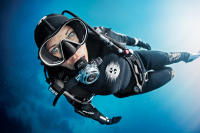
Explore dive destinations around the world. Whether you are planning a relaxed dive holiday or an adventurous dive trip, here you find the perfect location shaped by the ocean.
Discover marine wildlife and iconic dive sites worldwide. Whether you are drawn to coral reefs, wrecks, or big marine life, explore where divers dive and what lives beneath the surface.
Connect with certified dive centers and professional instructors worldwide. Whether you’re a beginner or experienced diver, find the perfect location to learn, explore, and enhance your diving skills.
Experience the ultimate diving adventure aboard world-class liveaboards. Explore remote dive sites, enjoy multiple dives per day, and wake up in paradise at some of the planet’s most incredible underwater destinations.
Discover dive sites around the world where activity is at its peak right now. Whether you are searching for exceptional wildlife encounters or the right dive season, here you find where the action is happening beneath the surface.
For liveaboard trips, we partner with LiveAboard.com to offer the widest selection of dive safaris worldwide.
Liveaboard diving holidays pack more diving in the same trip and allow divers to explore far-flung dive areas and see more marine life in the most beautiful dive destinations of the world.
Whether its wildlife tours, cultural visits and scenic hikes you are after or idyllic shores, swim stops and wonderful meals on board, an adventure cruise offers an amazing experience you won’t easily forget.
Famous the world over for its wildlife reserves and thrilling safaris, Africa has more to offer its visitors than lions, giraffes, and elephants. With over 35,000 kilometers (nearly 20,000 miles) of coastline and some of the world’s largest lakes, there is no shortage of exciting dive sites in Africa. Divers of all levels can take their pick between the volcanic walls and well-preserved wrecks of the Atlantic Ocean on Africa’s west coast, the clear, warm waters of the Indian Ocean on its east coast, the Red Sea’s colorful reefs, or the beautiful diversity of the Mediterranean. And the freshwater diving of Lakes Malawi, Tanganyika, and Victoria is sure to thrill even the most seasoned diver. Diving in Africa has it all.
Diving in Africa you can explore the wonders of the Red Sea or discover hidden gems like St. Helena Island.
Some of the world’s most paradisiac diving destinations in Asia can be found in Indonesia, Maldives, Malaysia, the Philippines, and Thailand.
Das Great Barrier Reef, das größte Korallenriff der Welt, ist der Inbegriff des Tauchens in Australien.
Diving in Occitanie – Discover the best scuba diving in France!
North America offers a wide variety of adventures for every type of diver such as ice diving in Alaska or cenote diving in Mexico.
Some of the top diving destinations in Oceania include Micronesia, Fiji, Polynesia, Palau, Guam or the Marshall Islands.
In South America, you will find plenty of dive sites to choose from, including Ilhabela, Abrolhos Archipelago, and Easter Island.
Explore scuba diving in the Atlantic Ocean – from temperate reefs to pelagic encounters. Discover top dive sites, conditions and marine life.
Discover scuba diving in the Baltic Sea, famous for historic wrecks and cold-water conditions. Learn where to dive and what to expect.
Experience world-class scuba diving in the Caribbean with vibrant reefs, walls and warm water. Explore the best dive destinations and conditions.
Explore scuba diving in the Indian Ocean, home to tropical reefs, sharks and clear waters. Discover top dive destinations and seasons.
Discover scuba diving in the Mediterranean Sea, from historic wrecks to caves and clear coastal waters. Find the best dive sites and seasons.
Explore scuba diving in the Pacific Ocean, known for vast reefs and big marine life. Discover top dive regions and underwater experiences.
Experience scuba diving in the Red Sea, famous for vibrant coral reefs and crystal-clear water. Discover the best dive sites and conditions.
You may know that our oceans cover more than 70 percent of the earth’s surface, but did you know that humans have only explored a total of less than five percent of the oceans? In celebration of World Ocean Day, we want to explore the best dive sites within the seven seas. From the small tropical islands of the Pacific to the crystal-clear waters of the Indian, over to the wild and rough Atlantic, every ocean has its diverse underwater characteristics and brings something unique to the table. This week, let us help you discover magical dive sites you have never heard of before!
Based on dives logged by our community in the past 2 weeks
White Rock, also known as White Rock and Black Rock, is located to the south of Nan Yuan Island, adjacent to Koh Tao. The whole site is a fairly large root, so no matter how many dives you do, you will never get bored of it, depending on the course you take, the depth and the type of life you observe. Beginners and seasoned divers alike should enjoy it.
Japanese Gardens enjoys the protection of Koh Nanguan, which generally makes it a very calm and easy site. The depth ranges from just a couple meters to about 16 meters.
One of the most famous dive sites on Koh Tao, this site features something for every experience level. Ranging from 5 to 19 meters, Twins is located just off the western side of picturesque Koh Nanguan and is a favorite of students and leisure divers alike.
30 to 45 minutes southwest of Koh Tao, these large pinnacles range from 30 to 5 m. Sandy ocean floor with big rocks on the south side. many cracks on the pinnacles where small wildlife can be found. The shallower parts of the pinnacles are covered in magnificent anemones.
Great site for training dives as there is a big sandy area ranging from 1m to 16m deep. There are two different areas of huge artificial reef concrete cubes good for buoyancy or tech training. An abundant and dense hard coral reef area is on the east side and rocky sloping reef is on the west side.
Located on the west-side of Nusa Penida Island, Crystal Bay has two coral reef formations separated by sand slopes. The combination of slopes and walls that form the topography at this dive site goes down to more than 50 meters and meets with large rock which is an ideal place for a cleaning station for sunfish.
This is the only historical shipwreck in Bali, ranked #3 in the world for Wreck diving! The wreck is 25 meters form shore at a depth of 4 to 29 meters below the surface with most of it occuring in a shallow area. This dive site does not have strong currents, has clear water, and warm temperatures. Difficult entry!
The main pinnacle of Chumphon Pinnacle comes as shallow as 14 meters and the deepest point of the site goes as deep as 45 meters. Offering great opportunities for divers at Open Water level through to XR level.
A steep slope on the north side of Gili Trawangan, from 5m down to 24m with a series of gullies at the bottom. A series of gradually deeper ridges running parallel to the beach is located between 25m and 40m.
Hans Reef is a gentle sandy slope that runs parallel to the shore and features a large coral mound and smaller outcrops. It is suitable for divers of all experience levels and is often used for training. It is excellent for night diving and navigation. Coral blocks attract a lot of marine life!
Freshwater Amphibians: Expert Divers Beneath the Surface
The Architects of the Reef
Critters of the Sea
“Humans” of the Underwater World
Living Stars of the Sea
Dominators of the World’s Lakes and Rivers
Mesmerizing Movers
Diverse Ocean Dominators
Curious, Playful, and Cute
Gentle Movers of the Sea
Making the Oceans a Rainbow of Color
The Best Dads in the Sea
Kings of the Oceans
The Most Majestic and Ancient Ocean Swimmer
Record Holder of the Seas
This is one our favourite dive sites since it has the widest range of wildlife. The reef gently slopes down from the island apart from the wall at the south west which drops 22-26 meters.
King Cruiser is rated as one of the best wreck dive sites in Asia, certainly Thailand. Having sank on May 4th in 1997 this is an amazing wreck dive sitting at over 30m, the top of the wreck is now around 18m. Suitable for Advanced and technical divers. Large Schools of fish and beautiful coral.
Viking Cave has a striking bay and a beautiful cave above the water, but the real deal is underwater a few hundred meters to the north of Viking Cave. A few years ago, the Phuket Marine Conservation department put down a beautiful artificial reef to re-establish marine life after the tsunami.
Shark Point is one of Phuket’s most popular dive sites. The three pinnacles of the Shark Point break the surface in a small area. The rest is submerged and covered in soft and hard corals. This is a great drift dive. You can frequently spot leopard sharks and bamboo sharks here, hence the name.
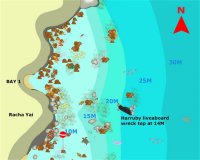
Bay 1 is located on the east side of Racha Yai Island. There are three wrecks to be explored at this dive site. Depths are between 5-25 meters and the white sandy beach is calm.
Bungalow Bay is a calm dive site and very good for beginners, try scuba, and open water students. Depth ranges from 5-20 meters. There is no current or waves. An artificial reef is built here as well.
Siam Bay is a dive site located in a large bay on the western side of Ko Racha Yai Island. The shallow waters are sandy with coral and rocks scattered throughout. Near the center of the bay, at a depth of 25m to 20m, there are elephants, Thai palatial houses, and ethnic objects that are popular among divers.
On the West side of Phi Phi Leh , north of Maya Bay, there is the bay of Malong, a frequented dive site between December and May, only dived occasionally during the Monsoon season.
Dock Mai Island is an island headed southeast from Phuket. You can dive on the east and west sides of the island. Depths are around 30 meters, and it is a wall dive all along the island. There are two large and one small cave on the east side at depths of 22M and 18M.
From Phuket to reach Racha Noi takes about a 2 hour boat ride. On the east coast the first part of the island Racha Noi is a dive site named Manta Reef. It is more or less a wall dive with a depth up to around 22 meters. The wall is fully covered with different corals.
Banana Bay is located on the east side of Racha Noi island. It consists of a sandy bottom and with hard coral. Depth inside the bay is 5-20 meters. If you swim away from the beach you can find 50 meters of depth.
Marina Bay is a dive site located on the western side of the North Island of Racha Noi. As you enter from the bay and head south, you'll see a dynamic landscape of rumbling megaliths overlapping each other. This is a popular dive site with swim-throughs dotted among the boulders to stimulate divers' sense of adventure. It is not uncommon for manta rays to appear.
South Tip is a dive site located off the southern tip of the South Island of Racha Noi. There are huge roots with depths ranging from 9m to 40m. The current is strong at all times so this dive site is recommended for advanced divers only.
Super divesite with plenty of fish. This submerged pinnacle is completely covered in softcorals and anemones and home to a great variety of species.
Camera Bay located west side of Racha Noi Island. Depht starts 5 meters and goes all the way to 60 meters. This is also good place for technical divers.
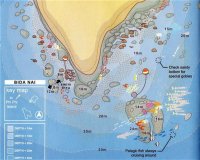
One of many dive sites at Phi Phi islands. Small rocky island south from Phi Phi Lee. Diving depht starts at 5 meters and goes to 30 meters plus. This site lies just to the north of Koh Bida Nok and is made of limestone cliffs hosting a large array of marine life.
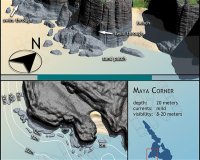
Found on the west side of Koh Phi Phi Lei is the beautiful Maya Bay, made famous for being the location of the movie ‘The Beach.’ The dive site of Maya Corner starts just inside the bay’s northern entrance, and follows the coastline north. It is a steep shelved reef, with occasional sections of walls.
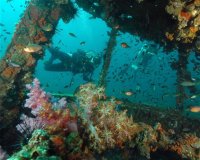
Decommissioned in 2014, the ship was donated and purposely sunk via controlled explosion to create a new dive site on 19 March 2014. The 47 metre long wreck sits almost upright (20 degree list) facing north to south (bow-stern), some 800-1000m to the east of Piley Bay (Ko Phi Phi Ley).
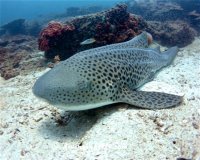
Shark Point is one the most famous and popular diving sites of Koh Phi Phi. It is maybe the best place to spot many Leopard Sharks resting and sleeping. The site consists of a large rock going down to 22 meters deep on a sandy bottom where the Sharks usually stay. Don’t worry, this kind of Shark is totally harmles
Mushroom Rock is the first dive site after the northern tip of Phi Phi Ley, on the west side of the island. A site formed of large pinnacles reaching the surface including the one shaped like a mushroom.
Situated on the east side of Phi Phi Ley, Palong Bay is the next bay north of the famous Maya Bay, made famous by the movie “The Beach.” This dive is s relatively simple one and is rarely affected by currents. The dive heads south from Palong Bay towards Maya Bay.
Deep freshwater cave system near Krabi, Thailand, One of Southeast Asia’s deepest. It features two interconnected entry ponds, dropping quickly to depths over 200m. Visibility varies, and the environment transitions from jagged to smooth, dark rock formations, offering a challenging dive for experience tech divers
Racha Noi North Point dive site offers a mesmerizing underwater experience with pristine coral gardens, abundant marine life, and thrilling drift dives along stunning granite boulders, attracting divers with the chance to encounter reef sharks, colorful tropical fish, and occasional manta rays.
Pileh Wall, on Phi Phi Leh, is a vibrant wall dive dropping to 20m. It’s renowned for colorful soft corals, gorgonian fans, and offers encounters with blacktip reef sharks in shallower areas. You’ll also find various reef fish, moray eels, and possibly turtles. Perfect for all dive levels.