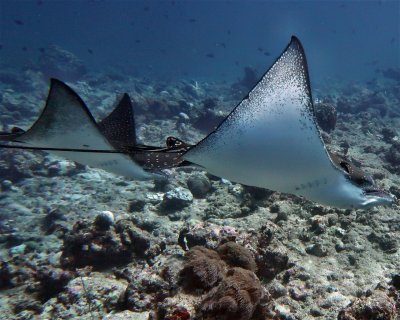
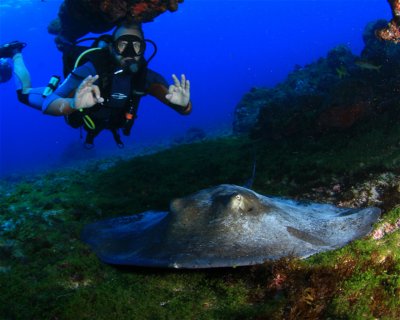
With over 500 different species of rays identified, this group of cartilaginous fish are more varied then their cousin the shark. Stingrays derive their name from their long, skinny tails, many of which have poisonous stingers used for self-defense. Due to these predominant stingers, please take caution when diving or walking through waters with stingrays. As long as you keep a safe distance, you can experience beautiful dives with them. They are mostly found on the seabed where they hide under the sand and feed on fish, crabs, worms, snails, and other mollusks.
Stingrays have a flat body and are usually diamond shaped. They are wider than they are long and can grow up to 2.5 meters long and almost 3 meters wide, depending on the species. Its gills and mouth are both found on the bottom of their bodies, whereas their eyes are on the top, enabling them to watch their surroundings from the sea floor. These animals are extremely diverse and come in all kinds of different sizes, colors, and patterns. Your chances of encountering them while scuba diving is high since they live in all tropical and sub-tropical oceans around the world. Click here to find the most popular areas to dive with stingrays.
Small Thila directly on the island of Villingilli on the offshore plateau in the direction of the channel between Raa and Baa Atoll. Usually a jump into the blue water east of the Thila above the plateau at the edge for approx. Let drift along 30m towards Thila and then slowly climb up the Thila. Current !!!!
Drift dive with the current flowing from the western tip of Kinohlas along the north side towards the small Thila. Lots of fish on the top of the reef, some really nice little overhangs deeper. Experienced divers dive to the thila, beginners stay over the overhangs and slowly ascend the Sandy Slope
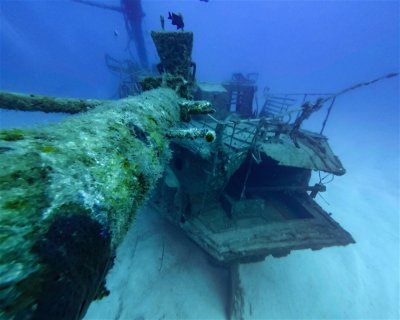
An easy dive site which is ideal for open water dives 3 and 4 OWD, but also offers nice macro stuff. You can find them at the mini wreck or the cargo that lies around the hull on the ground (16-19m). A little further out west (20m) we find a small thila.
Northern Arch is a renowned site that often has large pelagic species and current. The Arch is deep and bottoms out at over 36m, there is interesting structure on either side of the Arch and the Northern side of the Arch keeps sloping away down to 50m+.
A small reef with many different types of colorful coral. The reef roof is at a height of 6m and has a diameter of approx. 20m, at a depth of 25m it should be approx. 50m. On the west side an overhang with soft corals, further deeper a gap with giant moray eels and cleaner shrimp.
A very colourful wall dive. A short distance from Blue Mao Mao Arch on the opposite side of the Labrid Channel and in good conditions with no current, both sites could be seen on the same dive for divers good on their gas consumption and navigation. The walls maximum depth is around 20m.