Connect with certified dive centers and professional instructors worldwide. Whether you’re a beginner or experienced diver, find the perfect location to learn, explore, and enhance your diving skills.
Explore dive destinations around the world. Whether you are planning a relaxed dive holiday or an adventurous dive trip, here you find the perfect location shaped by the ocean.
Discover marine wildlife and iconic dive sites worldwide. Whether you are drawn to coral reefs, wrecks, or big marine life, explore where divers dive and what lives beneath the surface.
Experience the ultimate diving adventure aboard world-class liveaboards. Explore remote dive sites, enjoy multiple dives per day, and wake up in paradise at some of the planet’s most incredible underwater destinations.
Discover dive sites around the world where activity is at its peak right now. Whether you are searching for exceptional wildlife encounters or the right dive season, here you find where the action is happening beneath the surface.
For liveaboard trips, we partner with LiveAboard.com to offer the widest selection of dive safaris worldwide.
Liveaboard diving holidays pack more diving in the same trip and allow divers to explore far-flung dive areas and see more marine life in the most beautiful dive destinations of the world.
Whether its wildlife tours, cultural visits and scenic hikes you are after or idyllic shores, swim stops and wonderful meals on board, an adventure cruise offers an amazing experience you won’t easily forget.
Diving in Africa you can explore the wonders of the Red Sea or discover hidden gems like St. Helena Island.
Some of the world’s most paradisiac diving destinations in Asia can be found in Indonesia, Maldives, Malaysia, the Philippines, and Thailand.
Das Great Barrier Reef, das größte Korallenriff der Welt, ist der Inbegriff des Tauchens in Australien.
Diving in Occitanie – Discover the best scuba diving in France!
North America offers a wide variety of adventures for every type of diver such as ice diving in Alaska or cenote diving in Mexico.
Some of the top diving destinations in Oceania include Micronesia, Fiji, Polynesia, Palau, Guam or the Marshall Islands.
In South America, you will find plenty of dive sites to choose from, including Ilhabela, Abrolhos Archipelago, and Easter Island.
Explore scuba diving in the Atlantic Ocean – from temperate reefs to pelagic encounters. Discover top dive sites, conditions and marine life.
Experience world-class scuba diving in the Caribbean with vibrant reefs, walls and warm water. Explore the best dive destinations and conditions.
Explore scuba diving in the Indian Ocean, home to tropical reefs, sharks and clear waters. Discover top dive destinations and seasons.
Discover scuba diving in the Mediterranean Sea, from historic wrecks to caves and clear coastal waters. Find the best dive sites and seasons.
Explore scuba diving in the Pacific Ocean, known for vast reefs and big marine life. Discover top dive regions and underwater experiences.
Experience scuba diving in the Red Sea, famous for vibrant coral reefs and crystal-clear water. Discover the best dive sites and conditions.
Discover scuba diving in the Baltic Sea, famous for historic wrecks and cold-water conditions. Learn where to dive and what to expect.
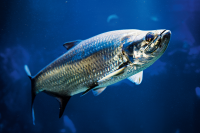
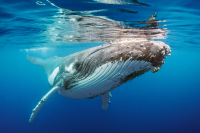
Kings of the Oceans
The Best Dads in the Sea
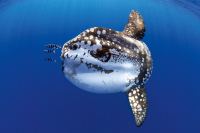
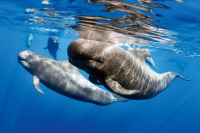
Gentle Movers of the Sea
Making the Oceans a Rainbow of Color
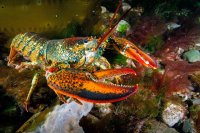
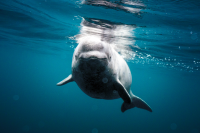
Dominators of the World’s Lakes and Rivers
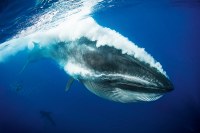
The Most Majestic and Ancient Ocean Swimmer
Diverse Ocean Dominators
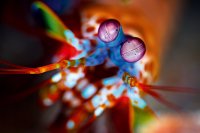
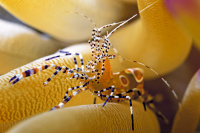
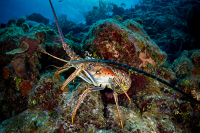
Critters of the Sea
Mesmerizing Movers
Record Holder of the Seas
“Humans” of the Underwater World
Curious, Playful, and Cute
Courses & Events
Dive Sites & Wildlife
Dive Center
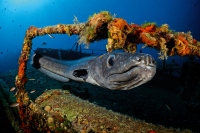
On the outermost part of Crater Mountain, a large World War II bomber engine rests in the sand. It is beautiful the descent while the engine begins to be drawn in the background. It is heavily colonized by different invertebrates and is a hiding place frequented by large Moray eels and conger eels.
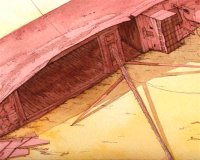
(This is one of the most popular dives in San Andres Island. It is a submarine mountain withdrawn of the profile of the Island about 20m. This beautiful mountain has a large cavity that resembles the crater of a volcano.
It is a very large dive site, which requires at least four dives to see it in its entirety. The minimum depth is - 10 meters, and the maximum is - 30 meters. There are vertical walls, others that gently decline, tunnels ...!
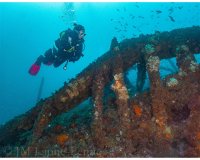
(maximum depth 12m) A beautiful dive where you glide through natural canyons and passages that create beautiful light entrances. It is a perfect dive for beginner divers, as well as for photography/video for more experienced divers, that enjoy shallow depths.
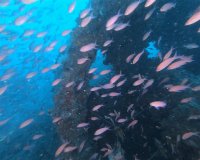
It is necessary to use a boat to make this beautiful dive. It is located on the west side of the cliff of Punta de la Mona, as a reference we can use two large cracks parallel to each other, inscribed in the same wall of the cliff.
This dive is for all kind of dive levels in the mediterranean part of the Island of Tarifa. Access is possible via the beach or the boat. Depth range from 0 to 12m.
An ideal place to begin to dive and make formations, we have from two meters deep to twelve, framed with a lot of marine life.
Located east of the bay of La Herradura. Ideal for courses and any level of training. The most advisable is to leave from boat but can also be done from the beach or jumping from the cliff (be careful with wind and tide changes, it may become impossible to climb where we have jumped).
One of the star dives, we start descending along the wall of the point until we reach the three canyons, at that moment we will decide the route to take to go down to the deepest area of Marina del Este.
3 Peñones, 1 dive and lots of marine life. Welcome in the Peñones del Santo, under the Cross, symbol of Almuñecar in front of the dive center "Buceo Almuñecar".
Dive for all dive levels on the Atlantic side of the island of Tarifa with the possibility of access from the beach or by boat. Depth between O and 12m.
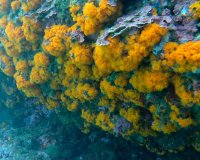
In this dive where we will reach between -18 and -24m depth, we will fly over a wall full of orange Astroid, we will go down to the beginning of the tip of the monkey or we will look out over its ridge to the blue. The name of this dive is given by an image of a virgin inside a small cave.
The descent at this dive site is made without a reference buoy. The entrance is at the edge of the cliff of the island platform located between six and eight meters, right at the junction between the Atlantic Ocean and the Mediterranean Sea. The cliff goes down to 22 meters and from there to 40-50 meters.
(maximum depth 16 m). It is a beautiful and simple dive, suitable for all diving activities. It has very varied landscapes: the rock wall that gives its name to the dive, nooks and crannies full of life to explore with the spotlights, Posidonia meadows full of fry.
THE BOQUETE IS A HOLE IN THE WALL OF THE ISLAND THROUGH WHICH WE CAN ACCESS THE SURFACE. IT IS LOCATED NEAR THE SAN ANDRES BUOY IN A NORTHERLY DIRECTION AT A DEPTH OF 6 METRES, ON THE ISLAND’S PLATFORM.
Diving point with a decent buoy located on the east side of the island of Tarifa. Anchorage depth is 15 meters. There is a possibility of drift diving. There is a possibility of seeing the wall area between 15 and 9 meters.
A deep, intense and beautiful dive located to the south of La Isla del Fraile and Cabo Cope, where we can find an average visibility of 15 metres. The anchorage is far from the coast, descending along the anchor.
Sunken ship from the beginning of the 20th century. It is called Las Calderas after the three that can be seen from the wreckage of the ship. The remains of the ship are scattered over a large area.
The name of this dive may mislead us into believing that the dive takes place in a cave, this is not true, the dive is done entirely on a wall, this name is only used as a reference to the place where the dive starts.
Wall dive with depth between 5 and 18 meters. Located between the San Andres buoy and Las Piscinas buoy. Possibility of travel in both directions and by the platform at the top.
This dive is on the Atlantic side of Tarifa Island. This is an easy dive site suitable for all levels. There is a wall area, sandy bottom, and rock corridors. The varied underwater configuration allows divers to make different routes between a depth of 8 and 18 meters.
Dive in the SW area of Tarifa. The descent is made by a buoy of the natural park of the straight. Depth between 16 and 30 meters.
Southernmost Diving Point in the Mediterranean area of Tarifa, just in front of Punta Marroquí on the island of pigeons, on the Levante side. Descent from rope to 16 meters depth. You have to be careful at the bottom with the iron remains of a small shipwreck.
A huge rock in the middle of a sandy inlet, just the place where incredible things happen. We will descend to a depth of 17m and we will be able to reach up to 40m. Some old cars and a jet ski rest on the sandy bottom.
One of our favorite dives; for all levels, where we reach -18m depth. We have cliffs, sandy bottoms, crevices, grottos and a wall decorated with Orange Astroid.
The use of a boat is required. This dive is sheltered from the Levante wind. It is one of the most famous for deep dives as you can reach 42 meters.
A quiet dive, perfect for observing the life of the place where we will not go deeper than 9 meters. We will be jumping from rock to rock, close to the cliff wall. It is ideal for diving when there is a strong upwelling.
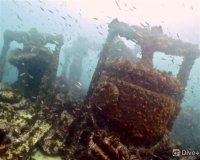
The San Andrés is a mid-19th century steamship wreck. You can see part of the deck and the two bushings on the sides of the blades that powered it. The ship has numerous holes full of life. It is easy to see groupers and conger eels here.
Cala Iza is a small cove located very close to it, with a very nice beach but difficult to access by land. It is best to do it by boat. It is very simple, adapted to any depth. It is the first of the natural site and the closest to La Herradura.
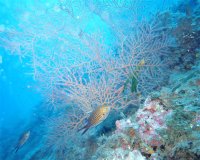
This dive has beautiful gorgonians from 22m to 29m (maximum depth 29 m). Descending the western slope of the Crater, we find this underwater valley that stands out for the presence of different spectacular gorgonians to inspect them closely.
(maximum depth 14 m)As the name suggests, this dive is an explosion of life and light. This dive is perfect to enjoy a simple and full of life dive, the anchorage point is at five meters, a rock where we will find some small octopus.
It is located to the east of the beach of Cantarriján, its access must be from boat since it belongs to the natural place of Maro. It is suitable for all levels and very easy to do. Maximum depth 14 meters.
One of the best dive sites for life and scenery. Without realizing it we will be in the middle of a rocky area about 14m deep, full of cracks, holes, large sandy areas. A place where life will overwhelm you.
LOCATED IN FRONT OF THE BEACH OF THE LAUNCHES OF TARIFF. SUNKEN BOAT ON A SANDY BED. MAXIMUM DEPTH 30 METERS. DIVE FOR ADVANCED DIVERS. RECOMMENDED THE USE OF NITROX.
DIVING WITH DPV SCOOTER TO GO ALL AROUND THE ISLAND. YOU CAN DO IT FROM THE ATLANTIC TO THE MEDITERRANEAN, OR THE OTHER WAY AROUND, DEPENDING ON THE ENVIRONMENTAL CONDITIONS. WE CAN SEE ALL THE VARIETY OF FISH THAT INHABIT THE WATERS AROUND THE ISLAND.
BOAT BUILT IN 1957, 50 METERS LONG, CALLED PUERTO DE PAJARES OR BARCO DE LA SAL. SUNK IN 1978 AFTER HITTING THE BOTTOM OF THE CABEZOS. IT RESTS ON A SANDY BOTTOM ON THE PORT SIDE WITH A SOUTH-NORTH ORIENTATION.
The Oak- Moore is an early twenthieth century vapor vessel, that is thought that it sunk in front of Punta Paloma, after hitting the Bajeta de los Cabezos.
This amazing wreck is located in the bay of Aguadulce. It is a dive for technical divers or those who have at least the Deep Specialty. The minimum depth is 36m and the maximum depth is 53m. With a length of 90m, this wreck will captivate you.
It is an easy and very beautiful dive, it looks like diving in an aquarium. Access can be both from the boat and from the beach. It is a wall dive and the maximum depth is 10 meters.
(This dive is ideal for initiation and refreshment. It is a beautiful area with an extraordinary light and full of schools of fry among rocks and Posidonia meadows.
Immersion point in the Atlantic zone of Tarifa in front of Los Lances beach. This point does not have a Natural Park buoy, so it is necessary to anchor with the boat’s anchor.
The Los Molinos dive starts at the limits of the Natural Park "Acantilados de Maro - Cerro Gordo", at the eastern end of Cerro Gordo that opens to the bay of La Herradura. Maximum depth 20 meters.
This dive spot is located a few meters from the end of the path that leads to the Manaca area. It is a simple dive, with a very comfortable and safe entry from the beach. Suitable for beginners and photographers who want to refine their techniques.
This dive site is located in the Cabo de Gata Natural Park in the Los Escullos area. Here there is a small promontory called “Punta del Esparto“ and a beach called “Cala Palo“ from which you can access the water.
Further east of the Palomas Cave we have this dive called the Yellow Wall. We can reach about 20 meters deep. It is the deepest part of the Cerro Gordo Natural Park.
(Depth up to 16). Back to the aquarium. This time the anchorage is different; at three meters, more sheltered from the Levante wind. The divers will make their way to 14-16 meters. The baptisms we stay in the paradise that we find between 3 and 5 meters.
This dive spot is located in front of La Isleta del Moro, a wonderful village in the Cabo de Gata Natural Park. It has easy access from the beach and the route takes place in a south-west direction.
(max. depth 22m)Named for being the outermost dive of the island, it has a spectacular wall that gives us a beautiful drop to 22m. It has a spectacular wall that gives us a beautiful fall to 22m. Its walls are full of life and although its presence of species is very changeable, it is the one where the most volumi
A little less than fifteen minutes by boat from the port of Villaricos, you will find this dive spot which, due to its depth, can only be explored by technical divers.
Diving spot without buoy markings in the Natural Park. Rock wall with sandy bottom, depths ranging from 10 to 25 m. Area with moderate to strong prevailing ebb currents.